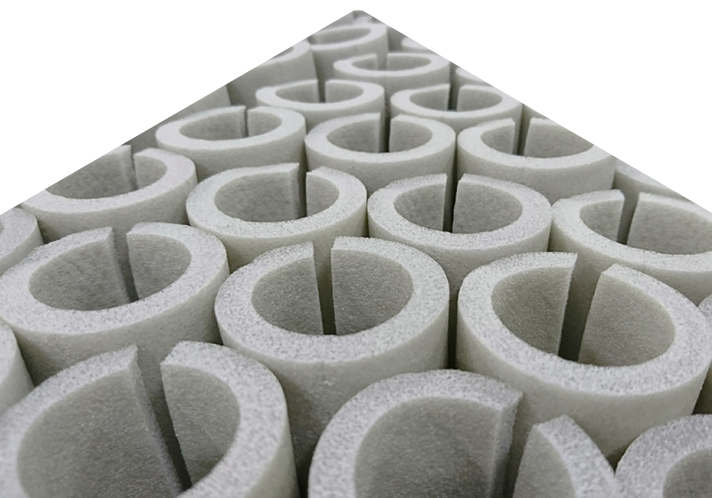
Foaming Agents Overview
Foaming agents play a critical role in modern plastics and rubber manufacturing by enabling the production of lightweight, cost-efficient materials with tailored mechanical and physical properties. By generating gas within a polymer matrix during processing, foaming agents create cellular structures that reduce density while improving insulation, cushioning, and material performance. Choosing the right foaming agent is essential, as factors such as decomposition temperature, gas yield, compatibility with the base resin, cell uniformity, and processing stability all directly impact the quality and efficiency of the final product.
Two of the most important product families in the UNICELL lineup are the D Series and the OH Series. While they share a commitment to consistent, high-quality foam structures, they are chemically distinct and serve different needs. Understanding when to use each one gives formulators a significant advantage in optimizing both process efficiency and final product performance.
UNICELL D Series: The Versatile All-Rounder
The UNICELL D Series is one of the most widely used and effective families of chemical foaming agents in the plastics and rubber industries, known for its versatility, reliability, and high-performance characteristics. Based on azodicarbonamide (ADCA), the D Series is designed to generate gases during thermal decomposition, forming a controlled cellular structure within a wide range of materials such as PVC, polypropylene, polyethylene, EVA, ABS, polystyrene, and various synthetic rubbers. This broad compatibility allows manufacturers to use a single foaming system across multiple applications, making it an efficient and practical solution for diverse production needs.
One of the key advantages of the D Series is its ability to produce a large volume of gas, which enables significant material expansion and contributes to lightweight product design while maintaining structural integrity. The result is a uniform, fine, microcellular foam structure that enhances both the aesthetic quality and mechanical performance of the final product. In addition, the D Series features a relatively high and well-defined decomposition temperature range, which improves processing stability and reduces the risk of premature decomposition during manufacturing.
Another important feature of the UNICELL D Series is its adaptability through the use of activators. By incorporating specific activators, manufacturers can precisely control the decomposition temperature and gas release behavior to suit different processing conditions. This flexibility allows the D Series to perform effectively across various manufacturing methods, including injection molding, extrusion, press molding, and calendering. Furthermore, different particle sizes within the D Series provide an additional level of control: smaller particles accelerate decomposition due to increased surface area, while larger particles allow for slower, more controlled gas release.
The D Series is widely used in real-world applications such as footwear (especially EVA shoe soles), PVC flooring and wall coverings, artificial leather, and a range of molded plastic and rubber products. Its ability to consistently produce high-quality foam structures, combined with its process stability and customization options, has made it a long-standing industry standard.
UNICELL OH Series: The Clean-Chemistry Alternative
While the D Series covers a broad range of applications, evolving regulatory pressure and the specific demands of certain polymer systems have created strong demand for a chemically distinct alternative. The UNICELL OH Series — based on p,p’-Oxybis(benzenesulfonylhydrazide) (OBSH) — addresses precisely those needs.
The most significant differentiator of the OH Series is that it does not produce ammonia upon decomposition. For manufacturers working in enclosed production environments, or selling into markets with tightening emissions standards, that’s a meaningful advantage. The foam it produces is also non-staining and non-discoloring, which matters in finished goods where appearance counts.
The OH Series is designed to work at the temperatures typically used for curing rubber, which means it fits naturally into rubber processing without requiring additional additives to get it to activate at the right moment. Fewer ingredients, fewer variables, and a formulation that’s easier to manage day to day. And unlike some foaming agents that leave behind residues you have to work around, the OH Series residues can actually contribute to the rubber curing process — a quiet bonus that can reduce the amount of other curing additives needed.
The series comes in a range of grades to suit different applications. Finer particle grades disperse easily and produce a uniform cell structure, while coarser grades give a wider processing window for situations where there’s a risk of the foaming agent activating too early. The right grade depends on the specific process and material, but the selection logic is straightforward.
In practice, the OH Series is a go-to choice for rubber weatherstripping and gaskets, pipe and thermal insulation, neoprene sponge profiles, PVC wall coverings and flooring, and foam sheet applications. It works across most standard plastic and rubber processing methods, making it a flexible option wherever a cleaner foaming agent is needed.
Need help deciding which is the right product for you? Fill out the form below to connect with our Technical Sales Team.